

NPCs you don't control
How I make NPCs for my solo games

When I GM, I have a stock of NPCs I can throw at the players. I know their backgrounds, motivations, and cunning plots to stab them in the back. One of my favorite things to do is pull a Pride & Prejudice and reveal a truer, more complex motivation underneath the dopey guard, the effete noble, or the meathead pit-fighter.
Playing by myself, though, I need a way to make NPCs that can surprise me and engage with my character in a way that defines the game as it deepens it. Otherwise, NPCs feel like vending machines I can kick over and loot.
When my players try to press on those vending machine NPC buttons, they find out quickly that these characters inhabit a living, reactive world. They have ideas and motivations of their own. Things to lose. People important to them worth fighting for.
That’s a harder limit to press on your own without devolving into maddening conversations with yourself.
So I wondered: how might I make NPCs that act on their own when I’m the only player?
To start, I assign NPCs 3 attributes I borrowed from Brandon Sanderson:
Likability
Competence
Agency
Each attribute is scored from -2 to +3, generated by rolling a d6 and subtracting 3.
During the game, when I roll an oracle, I roll a d6 and add the NPC’s relevant attribute to the result. It also works well for reaction rolls.
Higher attributes yield more “yes” results; lower ones yield fewer.


Gaming out the attributes
Likeability
Likeability measures how much others like, trust, sympathize with, or cooperate with the NPC (or a pet).
In fiction—and in life—we tend to like people others like. If nothing else, we see that at least someone likes them. They can’t be all bad. Even if they are, their dog is cute. My ultimate Pride & Prejudice trick: give the jerk a nice dog they love dearly. The murder hobos can take it from there.
Likability breaks down like this:
-2: Unpleasant, intimidating, abrasive, or simply difficult to relate to.
+3: Charming, warm, charismatic, or good at putting people at ease.
This serves as a useful guide when I’m trying to determine what an NPC might do or how they’ll react.
For example: Will the innkeeper give me a room without payment?
That’s probably a likeability question.
I make an oracle roll, modified by the innkeeper’s likeability. I don’t have to decide beforehand whether they are the sort of person to help people. Their Likeability tells me that during the game.
Even then, I can still be surprised by the oracle result. I’ve got structure to rely on, but room to discover and be surprised.
The innkeeper might be likable, but maybe their competency as a business owner won’t let them give away the room.
Competence
This is straightforward: How capable is this person at accomplishing things?
-2: Inexperienced, clumsy, uneducated, or perhaps maimed.
+3: Trained, talented, wise, or just plain lucky.
For example: Can the ferryman repair the boat?
I use competence to answer the question and roll an oracle.
With enough Competence, it’s a sure thing. But just because the ferryman can do something doesn’t mean they will.
To answer that question, I use agency.
Agency
Agency is how strongly an NPC pursues their own goals. It’s their ambition, self-esteem, and personal drive.
NPCs with low agency react to the world. They may be afraid, oppressed, defeated, or otherwise loath to act on their own behalf. If I meet them again, they’ll likely be exactly where I left them—or worse off.
NPCs with high agency act upon the world. They push out, fight back, resist, and move around. They make plans in my absence. They’re great antagonists or allies. They might even become my next PC.
Putting agency to work
When a scene ends with an NPC, I give them a chance to act on their own and pursue their goals.
This often works well as a kind of warm-up before I start playing, too. It stretches those creative muscles and gets the world moving before I put my character back into it.
I ask the oracle: Would this NPC act now?
Then I roll a d6 and add their agency to the result.
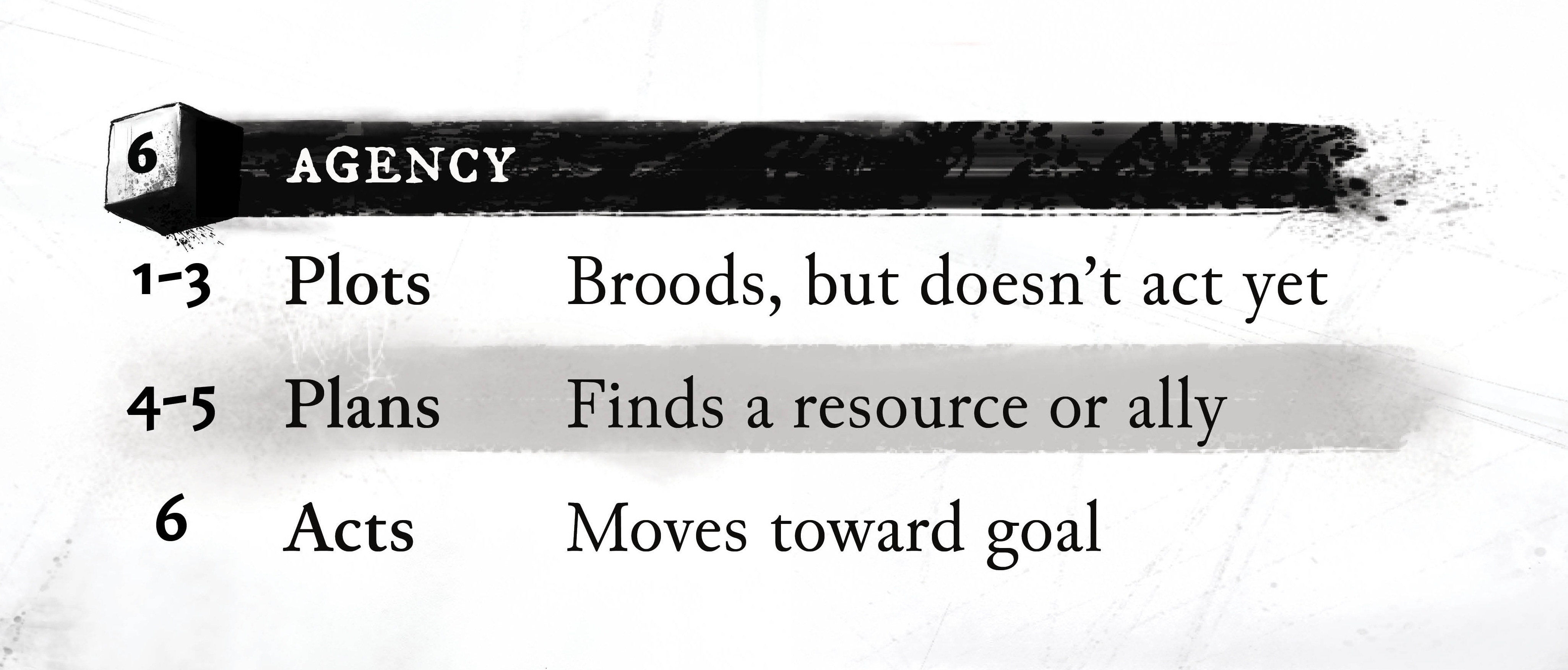
NPCs with negative agency do nothing. As Sanderson would put it, “they’re protagonists who fail to protag.”
NPCs with weak agency might never act at all. Those with middling agency may brood forever but never take active steps toward their goal.
We’ve all met this person.
To determine how successful they are, I look to their other attributes and roll the oracle again. With enough successes, they might find center stage in my next game.
For now, they’re acting in the background and changing the world around me while I’m hacking up zombie bears out in the muck.
Here’s an example
Let’s say I meet Santar, a cobbler in search of his missing daughter.
I give him some quick scores:
Likeability: 1
Competence: -1
Agency: 2
From this, I know Santar seems like a nice guy who’s fallen on hard times and can never quite get his life together.
But now that his daughter is missing, he’s putting that agency to work. He hires three Black Shields to help him find her.
That’s it. I write those details down and continue haggling with this poor fool to get some cheaper boots — I got zombie bears to hack, guy.
Later, though, I’ll give Santar an agency roll to see if he acts on his goal to find his daughter.
High roll, he does. Low roll, he plans or plots.
If he acts—and let’s say he does—I ask the oracle: Did Santar find his daughter?
Then I roll using his competence. Unfortunately for him, that’s only -1.
Two rolls, and I’ve got an event that occurred while I was hacking up zombie bears.
I never engaged with it. I didn’t have to (but I probably should have). Even without me, though, the game world kept churning.
Maybe I never worry about Santar again. Maybe this is my next quest. Maybe it’s Santar’s villain origin story.
The point is that my solo game evolved without me acting on it. There was no random event or well-placed bounty board. Instead, I created a character (one I’m starting to care about, to be honest) and they acted independently. That surprised me, me the solo player.
For me, that’s what RPGs give us: Discovery of things unexpected and strange.
Go meet some strangers.
—Odinson
I do like this - so far I've been using the general oracles in my game to do this. But the answers are abstract. I can see how overlaying some of this structure could support a more surprising response in the way they are reacting in any given encounter.
I love this and will be using it, but this is -2 to 3, not -3 to 3:
> Each attribute is scored from -3 to +3, generated by rolling a d6 and subtracting 3.